.png)
Is Freediving for Me?

Updated: Aug 6
The Most Frequently Asked Questions We Receive
If you have made it this far, freediving has probably sparked your curiosity. Perhaps you watched a video of someone descending beneath the surface in complete calm, or heard a friend describe the sense of peace they experienced while freediving. And, like many people approaching this sport for the first time, you have probably also found yourself with a few questions.
Is it safe? Do I need diving experience? What happens if I feel like I am running out of air? Can I practise if I do not feel relaxed in the water? How deep will I go? What will I learn during a course?
The good news is that the answers to most of these questions are much simpler than you might imagine.
In this article, we have gathered the questions and concerns we hear most frequently from people joining our courses for the first time. We hope that, by the end, you will feel more confident and discover that freediving is far more accessible than it may initially appear.
Do I Need Diving Experience to Start Freediving?
No.
You do not need any previous scuba-diving or freediving experience to begin. Many people arrive at their first course without ever having used diving equipment or completed a dive.
What truly matters is feeling comfortable, or at least relatively comfortable, in the water and being willing to learn. Everything else is developed gradually, with the guidance of an instructor and at a pace that respects each student’s individual needs.
What If I Do Not Feel Relaxed in the Water? Can I Still Freedive?
Yes, absolutely.
This is undoubtedly one of the questions we receive most often.
Many people believe they must feel completely relaxed before they can begin learning to freedive. However, relaxation is not a requirement for starting. It is a skill that develops throughout the learning process.
As you begin to understand how your body works, learn to breathe consciously and build confidence in a safe environment, a sense of calm starts to emerge naturally.
The aim is not to force yourself to relax. It is to create the right conditions for calmness to arise on its own.
Everyone experiences this process differently, and each person’s pace should always be respected. In fact, many people who now fully enjoy freediving began in exactly the same way: curious, slightly nervous and carrying a few doubts.

What Happens If I Feel Like I Am Running Out of Air?
This is often the greatest concern for beginners.
Interestingly, the first urge to breathe does not necessarily mean that your body has run out of oxygen. In most cases, it is a normal response to the increasing level of carbon dioxide during a breath-hold.
During a course, you will learn to recognise these signals and understand what they mean. As you gain a clearer understanding of how your body responds, fear begins to decrease and confidence starts to grow.
Freediving is not about fighting these sensations. It is about learning to listen to them and respond calmly.
How Long Will I Be Able to Hold My Breath?
Everyone has a different starting point.
There is no “correct” breath-hold time and no single goal that everyone must achieve. What often surprises beginners is that, with good technique and efficient breathing, most people discover that they can hold their breath for much longer than they expected.
Not because they are trying harder.
It happens because they learn to relax.
When the body uses less energy and the mind remains calm, oxygen is used much more efficiently.

Can I Freedive If I Am Not in Excellent Physical Condition?
Yes.
Although maintaining an active lifestyle is always beneficial, freediving does not depend solely on strength or physical endurance.
Technique, conscious breathing and the ability to relax often have a much greater impact than athletic fitness.
This is why people of different ages, professions and experience levels can all enjoy the sport.
Is It Normal to Feel Anxious While Holding My Breath?
Yes, it is completely normal.
Anxiety can appear whenever we face a new experience, especially one that takes us outside our comfort zone.
One of the most rewarding aspects of freediving is that many people arrive believing they will simply learn how to hold their breath, but end up discovering tools that also help them outside the water: managing stress, improving concentration and remaining present.
Over time, that initial anxiety often develops into a profound sense of calm.
What Are the Benefits of Freediving?
Although many people are drawn to freediving out of curiosity or a desire to explore the ocean, they soon discover that its benefits extend far beyond the underwater experience.
Freediving improves breathing awareness, supports concentration, helps with stress management and develops a stronger connection with the body.
It also teaches you to move efficiently, conserve energy and remain present in the moment.
For this reason, many freedivers describe the sport as a form of meditation in motion, in which silence, breathing and connection with the body become the true focus.
How Deep Does a Beginner Dive?
Depth is not the main objective of a first freediving course.
Everyone progresses at a different pace. The most important goals are to develop good technique, learn how to equalise the ears, breathe efficiently and feel comfortable in the water.
Many people reach depths during their first course that they had never imagined possible. However, this happens as a natural result of learning, not because they are pressured to dive deeper.
In freediving, we celebrate the quality of the experience far more than the number of metres reached.
What Will I Learn in a Freediving Course?
A beginner freediving course involves much more than learning how to hold your breath.
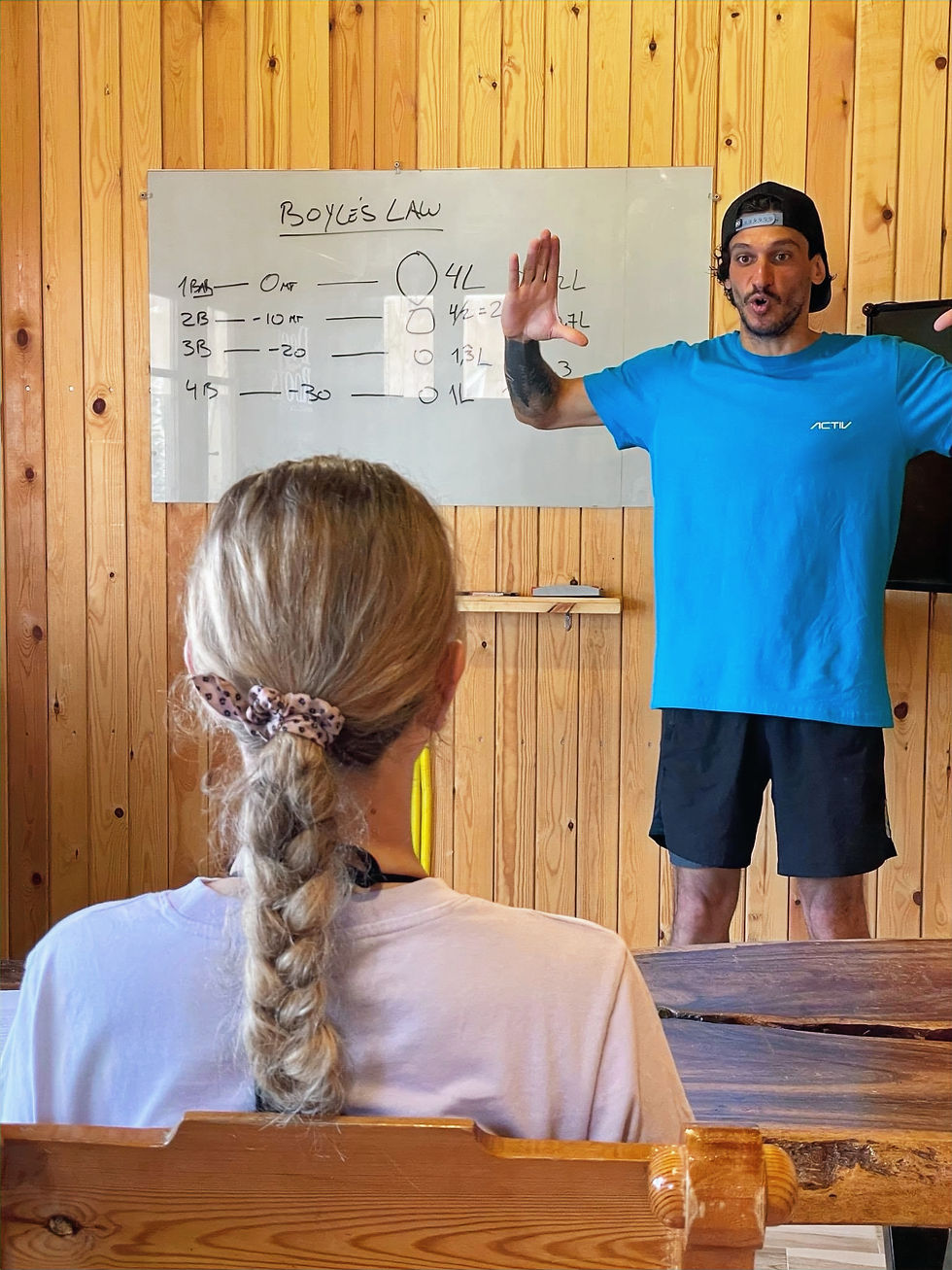
During the course, you will discover how your body responds during a breath-hold, learn breathing and relaxation techniques, practise equalisation, improve your swimming and finning technique, and become familiar with the essential safety procedures used in the sport.
You will also learn about freediving physiology, the mammalian diving reflex, rescue techniques and the importance of always practising with a trained buddy.
By the end of the course, you will not only have developed new skills in the water. You will also have a better understanding of your breathing and greater confidence in yourself.
What Should I Bring to My First Freediving Course?
If this is your first experience, do not worry about owning all the necessary equipment.
Most freediving schools allow students to rent or use the required equipment while they discover whether the sport is right for them.
You will generally need a freediving mask, snorkel, fins and a wetsuit suited to the water temperature. Your instructor will explain which equipment to use and help you choose the most appropriate options for the location and conditions.
The most important things to bring are an open mind, curiosity and a willingness to learn.
Can Everyone Practise Freediving?
Most healthy people can practise recreational freediving safely when they learn with certified instructors and follow the correct safety procedures.
However, certain medical conditions, particularly cardiovascular, pulmonary or neurological conditions, may require medical assessment before starting.
If you have any concerns about your health, the safest approach is to consult a medical professional before beginning your training.
How Do I Know Whether Freediving Is for Me?
The best way to find out is to experience it for yourself.
You do not need to be an athlete, have previous diving experience or feel completely relaxed from your first day. You only need curiosity, a willingness to learn and the desire to discover a different way of connecting with your breathing and with the water.
Freediving reminds us that we are often capable of far more than we imagine. Not because we force our limits, but because we learn to listen to our bodies, trust them and enjoy the process.
You may discover that freediving changes not only the way you breathe underwater, but also the way you experience every breath above the surface.
Take the First Step
Everyone comes to freediving for a different reason.
Some people begin because they dream of spending more time underwater, calmly exploring a reef, observing fish from close range or discovering an underwater world that once seemed inaccessible.
Others are searching for something more internal: a way to connect with their breathing, find silence, deepen their relationship with the ocean or discover a new way of being present.
There is no single reason to begin freediving. Everyone finds their own path within the sport.
However, many people eventually discover the same thing: beyond learning to hold their breath, freediving becomes an opportunity to understand themselves more deeply.
Through breathing, movement and experience in the water, we begin to uncover abilities that may have remained dormant for years. We learn that our bodies and minds have a far greater capacity for adaptation, calmness and learning than we previously imagined.
If you feel curious, if the ocean is calling you or if you simply want to discover a new way of connecting with your breathing and with yourself, the invitation is simple:
Take the first step!
Check our courses for beginners:


Comments